
Mobile Apps: the difference between hybrid and native development

Every company that wants to build a mobile app faces the same question early on: should it be native or hybrid? The answer shapes your budget, your timeline, and ultimately the quality of the experience you deliver to users.
There is no universally correct answer to this question — but there is a correct answer for your specific project. At Codepoint, we've built mobile applications using both approaches. What we've learned is that the decision comes down to a handful of variables: where your users are, what your app needs to do, and what your business can invest over time.
A native app is built specifically for a single platform using that platform's own tools and programming language. For iOS, that means Swift or Objective-C. For Android, it means Kotlin or Java. Each app is a separate codebase, written from scratch for its target operating system.
The result is an application that behaves exactly the way the platform intends. It has direct access to every device feature — camera, GPS, biometric authentication, NFC, background processing — with no abstraction layer in between. It follows each platform's design conventions natively, which means iOS users see iOS-standard interactions, and Android users see Android-standard ones.
Native development means writing the same app twice — but it also means each version is optimised for the people who will actually use it.
Performance in native apps is consistently excellent because the code compiles directly to the device's hardware. There are no translation layers, no JavaScript bridges, no rendering overhead. For anything that demands real-time responsiveness — complex animations, live video processing, high-frequency sensor data — native is still the benchmark.
Hybrid development lets you write a single codebase that runs on both iOS and Android. Frameworks like React Native have matured significantly over the past few years and are now capable of producing apps that feel genuinely polished — not like web apps wrapped in a container, which was the perception (often justified) of earlier hybrid tools.
React Native, the framework we use at Codepoint alongside Expo, compiles JavaScript components to real native UI elements. It is not a WebView wrapper — the output is genuine native code that behaves and performs like any other iOS or Android app.
The primary advantage of hybrid is clear: one codebase, two platforms. That translates directly into faster development cycles, lower initial investment, and a single team that can maintain both iOS and Android simultaneously.
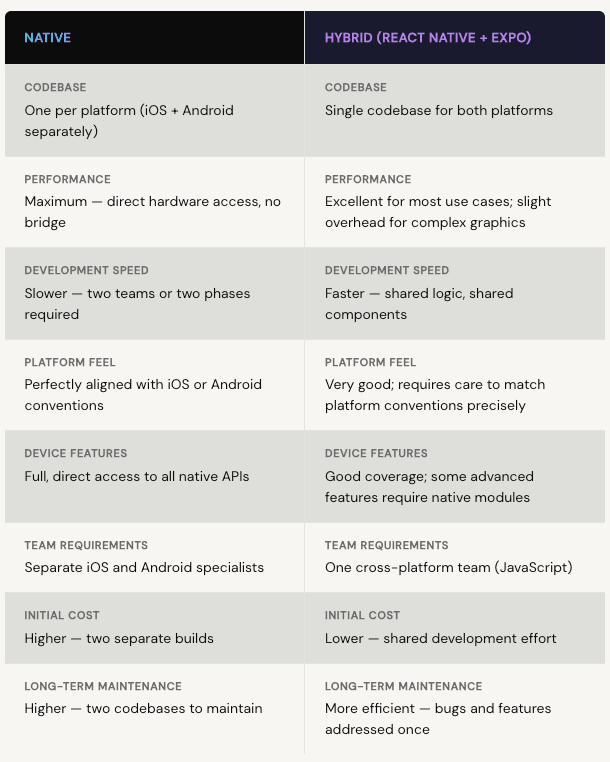
One of the most persistent myths in mobile development is that hybrid apps are noticeably slower than native ones. In 2025, for the vast majority of applications — social platforms, ecommerce, productivity tools, dashboards, booking systems — this is simply not true. React Native has closed the gap to the point where most users cannot distinguish it from a native app in everyday use.
Where the difference still matters is in compute-intensive scenarios: real-time 3D rendering, AR/VR features, ML processing on-device, or applications that interact intensely with hardware sensors. For these cases, native development remains the stronger technical choice.
Rather than treating this as a philosophical debate, it helps to think about it in concrete terms. In our experience, the decision becomes clear once you understand your constraints and ambitions.
Consider native when
Your app requires complex hardware integration (AR, advanced camera pipelines, real-time sensor data)
Performance is business-critical and must be absolute — gaming, real-time video, or precision UX
You plan to build a distinct, deeply differentiated experience on each platform
Your budget accommodates two separate development tracks and long-term maintenance teams
You have a product with high user expectations, where even subtle performance degradation would impact retention
Consider hybrid when
You need to be present on both iOS and Android without building two separate products
Time to market is a priority — launching faster creates real competitive advantage
Your budget is better deployed towards product features than duplicated infrastructure
Your core product logic is the same across platforms and duplication would be wasteful
You're validating a new product or market and need to iterate quickly based on user feedback
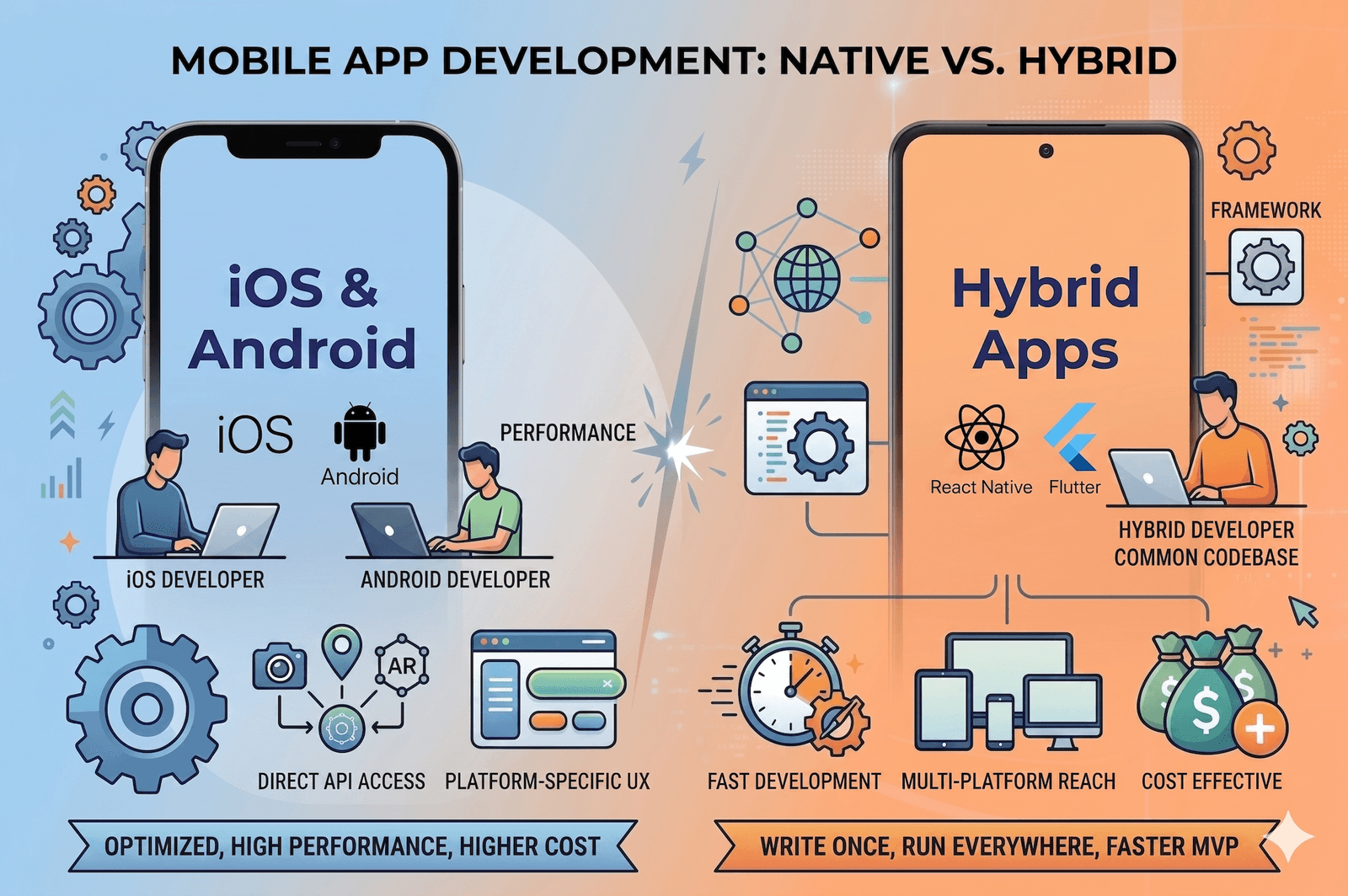
Most of the mobile projects we work on at Codepoint are built with React Native. This isn't a default choice — it's the result of assessing each project honestly against the criteria above. The majority of business applications, even complex ones, do not require the absolute peak of native performance. What they require is a reliable, well-designed experience, delivered quickly, maintained efficiently, and ready to evolve as the product grows.
Where we've recommended native development is when a client's use case genuinely demands it — specific hardware integrations, performance-critical features, or a platform-first identity that is central to the brand. The recommendation is always driven by the product, not by a preferred stack.
A melhor app móvel é a que é construída, lançada e melhorada. Uma arquitectura "perfeita" que demora o dobro do tempo a entregar raramente é a escolha certa.
It's worth noting that hybrid and native are not always mutually exclusive. Some products start hybrid and introduce native modules for specific features that require it — biometric authentication, custom camera behaviour, or deep system integrations. This modular approach gives you the efficiency of a shared codebase with the capability of native where it matters.
React Native is designed to accommodate exactly this. You can write most of your application in JavaScript and drop down to native Swift or Kotlin for the handful of screens or features that justify it.
There are questions worth asking before this decision is made. Who are your users — iOS-dominant, Android-dominant, or split? What features are truly non-negotiable at launch, and what can be deferred? What does your team look like today, and what does it need to look like in two years? What is the realistic cost of maintaining two codebases versus one?
These questions don't have abstract answers. They have answers specific to your product, your organisation, and your market. Our job as a development partner is to help you answer them clearly — and then build what actually makes sense.